Why Your Proposals Go Quiet (And the Five Agreements That Fix It)


You had a great call. They nodded, asked good questions and said, “Send me something.” You stayed up late writing the proposal, sent it first thing, and then nothing.
A week later you follow up. Then again. By the third email you feel like you’re chasing, and you hate chasing.
If you’re a founder who is still the main salesperson in your business, you know this feeling. It isn’t a lead problem. It’s a conversion problem, and it can be fixed.
If this sounds familiar
- You have a record month, then a terrible one, with the same effort.
- Prospects love the call, take the proposal, then go quiet.
- Buyers push back on price, even after telling you what the problem was costing them.
- Your team can’t sell the way you do, so every big deal comes back to you.
- You’ve spent money on marketing and more leads, and it still hasn’t fixed it.
- You can’t take a proper holiday, because the pipeline stops when you do.
When founders describe this to me, the words are always the same: exhausted, frustrated, and quietly annoyed with themselves, because they know they’re good at this. Selling feels heavy when all of it sits on your shoulders.
Why it happens
Proposals rarely go quiet because of the proposal. They go quiet because of what wasn’t agreed before it was sent.
When a buyer receives a proposal without clear agreement on the problem, the outcome, the budget and who decides, they have nothing to measure it against except price. So they compare you on price, or they do nothing, which is the most common decision of all.
Founders skip these steps for good reasons. You know your service inside out, you want to help, and the call went well. But “it went well” is a feeling, not an agreement.
The second reason is that your sales process lives in your head. It works when you run it on a good day. Your team can’t repeat it, and you can’t fix it, because it has never been written down.
What it’s really costing you
Look at the pipeline you already have. If two more deals a quarter closed from it at a $25,000 average deal, that’s $200,000 a year. You’ve already done the work to earn that revenue, and it’s walking out the door.
There’s a quieter cost too. Every proposal that goes quiet chips away at your confidence. Every month that depends on you makes the business harder to step back from, and harder to sell one day.
If nothing changes, next year looks exactly like this one: starting from zero on the 1st of every month, chasing your tail, and wondering why.
“You don’t have a lead problem. You have a conversion problem.”
Start here: the five agreements before any proposal
Before you write your next proposal, check these five agreements are in place. Missing even one is usually why a proposal goes quiet.
1. The problem, and what it’s costing them
In their words, not yours.
Ask: “What happens if this isn’t fixed in the next six months?”
If they can’t put a cost on it, they won’t put a priority on it.
2. The outcome, and how it will be measured
Ask: “If we were sitting here in 12 months celebrating, what would have happened?”
Now your proposal is measured against their goal, not a competitor’s price.
3. The budget range
Ask: “Have you set aside a range for this, or would it help if I shared what clients typically invest?”
A range agreed on the call means no surprises on the page.
4. Everyone involved in the decision
Ask: “Apart from yourself, who else will add value, have input or give feedback on this?” Then: “When they read the proposal, what will they need to see to feel confident saying yes?”
A proposal sent to one person and decided by three is a proposal that stalls.
5. The decision date
Ask: “When would you like this in place, and when do you need to decide to make that happen?”
Then book the next conversation in the diary before you hang up. A date gives you both permission to follow up, so it never feels like chasing.
With all five in place, your proposal becomes a summary of what you’ve already agreed. It stops being a pitch, and it stops going quiet.
See how much revenue is leaking from the pipeline you already have
The free Revenue Leakage Analyser shows where deals are slipping and what it’s costing your business.
Take the Free Revenue Leakage AnalyserFrom being the sales engine to owning one
The five agreements are one small part of a bigger system. On their own they’ll save a few deals. They won’t change how your business sells.
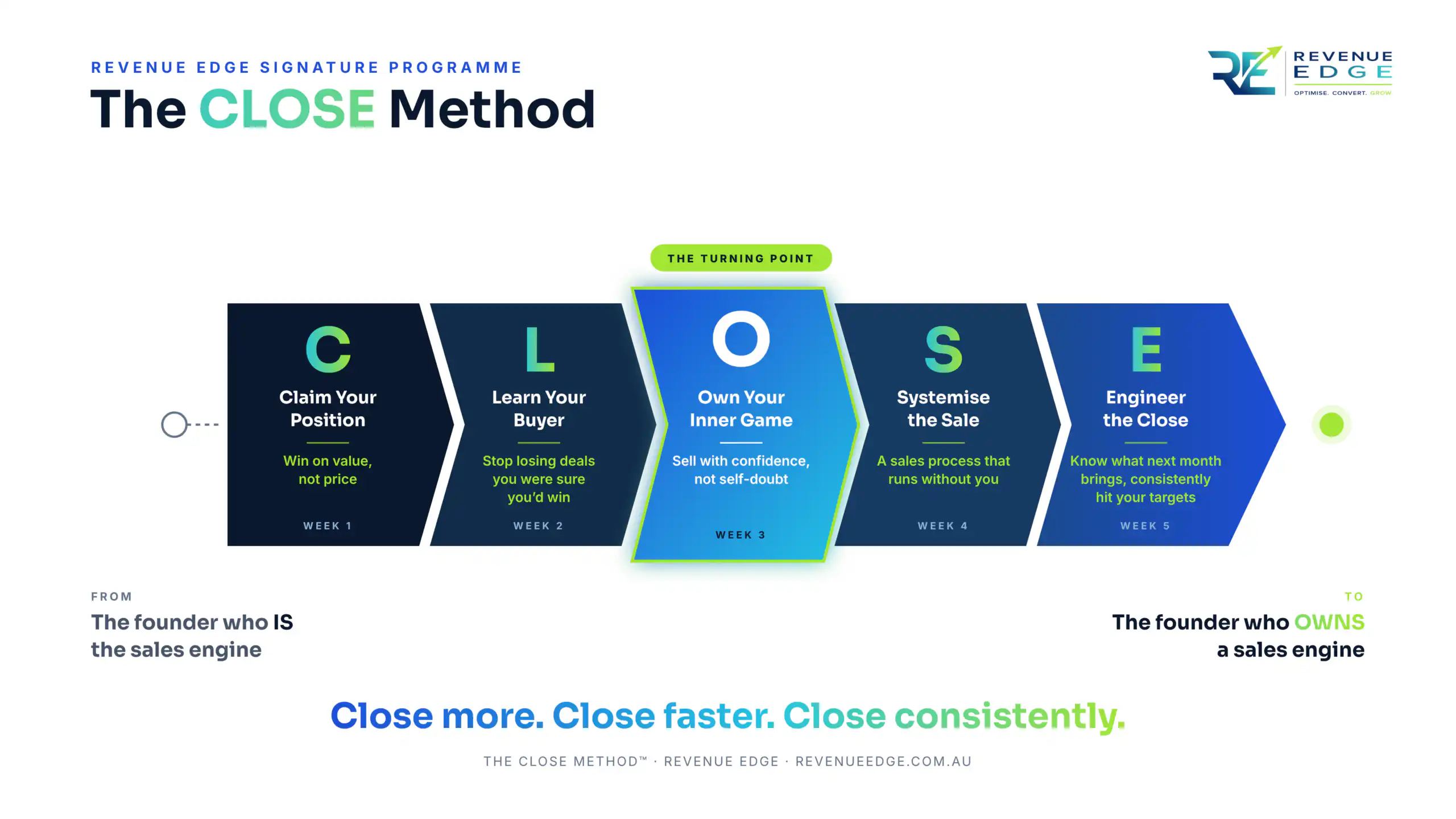
That’s why I built The CLOSE Method, a five-step sales system for B2B founders:
- Claim Your Position: win on value, not price.
- Learn Your Buyer: understand buyer behaviour and psychology, and stop losing deals you were sure you’d win.
- Own Your Inner Game: sell with confidence, not self-doubt.
- Systemise the Sale: a sales process that runs without you.
- Engineer the Close: know what next month brings, and hit your targets consistently.
When I ask founders what they want, it’s rarely more leads. They want to feel lighter. Calm going into a sales call instead of anxious. In control of their pipeline instead of at its mercy. They want to watch their team close a deal without them, and take a holiday without the pipeline stopping.
That’s the shift: from the founder who IS the sales engine to the founder who OWNS one.
Why I built this
I’ve sat in both seats. I’ve built and sold businesses as a founder, including Hollywood Glamour, New Zealand’s largest hair extension provider, and I’ve sold enterprise SaaS at HubSpot. After more than 20 years, the pattern is clear. Strong businesses rarely have a lead problem. They have leaky revenue.
“We never had a proper sales process in place and no way to track sales conversions. Mandy developed our way of selling, increased our sales conversions and documented the whole process so anyone in the team can pick it up.”
Sonia Majkic, Co-Founder and MD, 3 Phase Marketing“Mandy’s close rate was truly remarkable. I’ve never seen anything like it.”
Francesca Battan“Mandy’s strategic approach helped the sales team land a number of great deals.”
Sean Wang, Head of Partner Acquisition JAPAC, HubSpot
Common questions on this topic



Ready to stop chasing and start closing?
The CLOSE Method is a six-week live program for Australian B2B founders. Applications are open for the founding intake, with founding pricing for the first group only.
Not ready yet? Start with the five agreements on your next proposal, and see what your pipeline could be worth.
Close more. Close faster. Close consistently.